

Tiếng Anh 10 Unit 3 Music (sách Global Success) cung cấp hệ thống từ vựng, ngữ pháp và bài tập thực hành về chủ đề Âm nhạc. Bài học giúp học sinh lớp 10 nâng cao kỹ năng nghe, nói, đọc, viết tiếng Anh, đồng thời phát triển khả năng giao tiếp và ứng dụng ngôn ngữ trong thực tế. Bài viết dưới đây tổng hợp đầy đủ kiến thức trọng tâm, ví dụ minh họa và đáp án chi tiết hỗ trợ việc ôn tập hiệu quả.
Tóm tắt kiến thức tiếng Anh 10 Unit 3 Music (sách Global Success)
Tiếng Anh 10 Unit 3 Music mang đến cho học sinh những kiến thức phong phú xoay quanh chủ đề Âm nhạc, thông qua hệ thống từ vựng chuyên đề và các bài luyện tập phát triển kỹ năng đọc hiểu, nghe và giao tiếp.
Ngoài ra, bạn sẽ được rèn luyện cách phát âm chính xác các từ và cụm từ liên quan đến âm nhạc (Words and phrases related to music). Bạn còn được làm quen với chủ điểm ngữ pháp quan trọng gồm câu ghép, động từ nguyên mẫu có “to” và nguyên mẫu không “to” (compound sentences, to-infinitives and bare infinitives). Những kiến thức này đóng vai trò thiết thực trong việc nâng cao khả năng sử dụng tiếng Anh trong giao tiếp hàng ngày và học thuật.
>>> Tìm hiểu thêm: Tiếng Anh 10 Unit 1 Family Life: Đáp án đầy đủ từng bài tập
Đáp án bài tập tiếng Anh 10 Unit 3 Music (sách Global Success)
1. Từ vựng cần biết
√ Danh từ:
• Idol /ˈaɪdəl/: Thần tượng
• Fan /fæn/: Người hâm mộ
• Award /əˈwɔːd/: Giải thưởng
• Trumpet /ˈtrʌmpɪt/: Kèn trumpet
• Comment /ˈkɒment/: Bình luận
• Artist /ˈɑːtɪst/: Nghệ sĩ
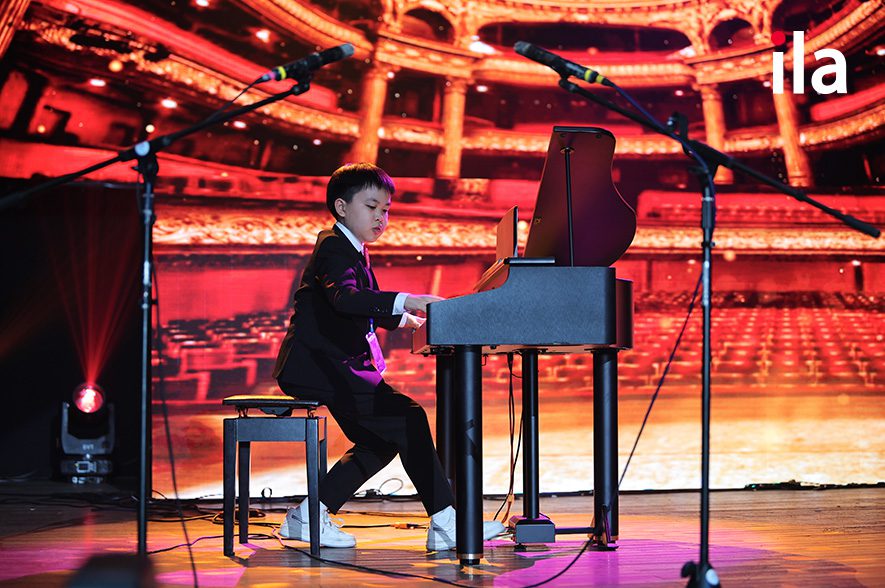
• Audience /ˈɔːdiəns/: Khán giả
• Competition /ˌkɒmpəˈtɪʃn/: Cuộc thi
• Judge /dʒʌdʒ/: Giám khảo
• Performance /pəˈfɔːməns/: Màn trình diễn
• Career /kəˈrɪə(r)/: Sự nghiệp
• Participant /pɑːˈtɪsɪpənt/: Người tham gia
• Event /ɪˈvent/: Sự kiện
• Atmosphere /ˈætməsfɪə(r)/: Bầu không khí
• Experience /ɪkˈspɪəriəns/: Trải nghiệm
• Stage /steɪdʒ/: Sân khấu
• Stadium /ˈsteɪdiəm/: Sân vận động
• Costume /ˈkɒstjuːm/: Trang phục
• Festival /ˈfestɪvl/: Lễ hội
• Composer /kəmˈpəʊzə(r)/: Nhà soạn nhạc
• Contest /ˈkɒntest/: Cuộc thi
• Viewer /ˈvjuːə(r)/: Người xem
• Teenager /ˈtiːneɪdʒə(r)/: Thiếu niên
• Works /wɜːks/: Tác phẩm nghệ thuật hoặc âm nhạc
• Argument /ˈɑːɡjəmənt/: Cuộc tranh luận
• Runner-up /ˌrʌnər ˈʌp/ (số ít) / runners-up /ˌrʌnəz ˈʌp/ (số nhiều): Á quân, người (hoặc đội) về nhì
• Hit /hɪt/: Bản nhạc nổi tiếng, bài hát được yêu thích
• Psychic /ˈsaɪkɪk/: Nhà ngoại cảm
• Moon-shaped lute /muːn ʃeɪpt luːt/: Đàn nguyệt
• Bamboo clapper /ˈbæmbuː ˈklæpə(r)/: Phách tre
√ Động từ:
• Receive /rɪˈsiːv/: Nhận
• Perform /pəˈfɔːm/: Biểu diễn
• Upload /ʌpˈləʊd/: Tải lên (mạng)
• Reach /riːtʃ/: Đạt tới, vươn tới
• Decide /dɪˈsaɪd/: Quyết định
• Attract /əˈtrækt/: Thu hút
• Participate /pɑːˈtɪsɪpeɪt/: Tham gia
• Identify /aɪˈdentɪfaɪ/: Nhận ra
• Eliminate /ɪˈlɪmɪneɪt/: Loại bỏ, loại trừ, loại khỏi (cuộc thi, vòng đấu…)
• Hesitate /ˈhezɪteɪt/: Lưỡng lự
• Dress up /dres ʌp/: Hóa trang
• Remain /rɪˈmeɪn/: Duy trì
• Spread /spred/: Lan truyền
• Praise /preɪz/: Khen ngợi, ca ngợi
• Reveal / rɪˈviːl/: Tiết lộ
√ Tính từ:
• Relax /rɪˈlæks/: Thư giãn
• Talented /ˈtæləntɪd/: Có tài năng
• Latest /ˈleɪtɪst/: Mới nhất
• Well-known /ˌwel ˈnəʊn/: Nổi tiếng
• Ordinary /ˈɔːdnri/: Thông thường, bình thường
√ Cụm từ:
• Social media /ˌsəʊʃl ˈmiːdiə/: Mạng xã hội

• Take place /teɪk pleɪs/: Diễn ra
• Art exhibition /ɑːt ˌeksɪˈbɪʃn/: Triển lãm nghệ thuật
• Traditional music /trəˈdɪʃənl ˈmjuːzɪk/: Nhạc truyền thống, âm nhạc dân gian
• Musical instrument /ˈmjuːzɪkl ˈɪnstrəmənt/: Nhạc cụ
• Charity concert /ˈtʃærəti ˈkɒnsət/: Buổi hòa nhạc từ thiện
• Family gathering /ˈfæməli ˈɡæðərɪŋ/: Buổi họp mặt gia đình
• Music recording /ˈmjuː.zɪk rɪˈkɔː.dɪŋ/: Bản ghi âm âm nhạc
• Cash prize /kæʃ praɪz/: Giải thưởng bằng tiền mặt
• Stadium ticket office /ˈsteɪdiəm ˈtɪkɪt ˈɒfɪs/: Phòng vé sân vận động
• Look forward to /lʊk ˈfɔːwəd tuː/: Mong đợi, trông chờ
• Be good at something /biː ɡʊd æt ˈsʌmθɪŋ/: Giỏi về việc gì, có khả năng làm tốt điều gì đó
• Play an important role /pleɪ ən ɪmˈpɔːtnt rəʊl/: Đóng vai trò quan trọng
• Be not in favour of /biː nɒt ɪn ˈfeɪvər əv/: Không ủng hộ, không đồng tình với điều gì
• Make someone fall asleep /meɪk ˈsʌmwʌn fɔːl əˈsliːp/: Khiến ai đó buồn ngủ
• Let someone do something /let ˈsʌmwʌn duː ˈsʌmθɪŋ/: Cho phép ai làm gì
• Party atmosphere /ˈpɑːti ˈætməsfɪə(r): Không khí tiệc tùng
• Depend on /dɪˈpend ɒn/: Phụ thuộc vào
• Be recognised as /bi ˈrekəɡnaɪzd æz/: Được công nhận
• Participate in /pɑːˈtɪsɪpeɪt ɪn/: Tham gia vào
>>> Tìm hiểu thêm: Bộ từ vựng về các thể loại nhạc bằng tiếng Anh cực hay
2. Bài tập tiếng Anh 10 Unit 3: Music Getting Started (trang 28, 29)
a. Bài tập 1
Listen and read. (Nghe và đọc.)
• Mai: That pop singer looks great, Ann! (Ca sĩ nhạc pop đó trông tuyệt thật đấy, Ann!)
• Ann: Yeah. He’s a popular teen idol around the world now. (Ừ. Hiện giờ anh ấy là thần tượng tuổi teen nổi tiếng khắp thế giới.)
• Mai: Really? You must be a fan of his! (Thật vậy sao? Cậu chắc hẳn là fan của anh ấy rồi!)
• Ann: Yep, I really love his music. He’s a talented artist who can write music and play many musical instruments. He has received several awards such as Grammy, Billboard Music and Teen Choice Awards. (Đúng vậy, mình thực sự thích âm nhạc của anh ấy. Anh ấy là một nghệ sĩ tài năng, có thể sáng tác nhạc và chơi nhiều loại nhạc cụ. Anh ấy đã nhận được nhiều giải thưởng như Grammy, Billboard Music và Teen Choice Awards.)
• Mai: Wow! Did he go to a music school? (Wow! Anh ấy có học trường nhạc không?)
• Ann: No, he didn’t, but he learnt to play the piano, drums, guitar, and trumpet by himself. When he was a teenager, he performed at the local theatre in his home town during the tourist season. (Không, anh ấy không học, nhưng anh ấy đã tự học chơi piano, trống, guitar và kèn trumpet. Khi còn là thiếu niên, anh ấy biểu diễn ở nhà hát địa phương tại quê nhà vào mùa du lịch.)
• Mai: How did he become famous? (Làm sao anh ấy trở nên nổi tiếng vậy?)
• Ann: Well, when he was 12, his mother started to upload his cover song videos on social media, and the videos made him an online star within a couple of months. (À, khi anh ấy 12 tuổi, mẹ anh bắt đầu đăng các video anh hát lại các bài nổi tiếng lên mạng xã hội, và những video đó đã khiến anh trở thành ngôi sao mạng chỉ trong vài tháng.)
• Mai: Sounds amazing! (Nghe tuyệt thật đấy!)
• Ann: And his videos have reached more than two billion total views. Many fans say that his beautiful songs have helped bring more love into their lives. (Và các video của anh ấy đã đạt hơn hai tỷ lượt xem. Nhiều fan nói rằng những bài hát tuyệt đẹp của anh ấy đã giúp mang lại nhiều tình yêu hơn cho cuộc sống của họ.)
b. Bài tập 2 tiếng Anh 10 Unit 3 Music (sách Global Success)
Read the conversation again and answer the following questions. (Đọc lại đoạn hội thoại và trả lời các câu hỏi sau.)
1. Who are Ann and Mai talking about?
2. What is he good at?
3. What made him popular?
Đáp án:
1. They are talking about a popular teen idol around the world now.
2. He is good at writing music and play many musical instruments.
3. His cover song videos made him popular.
c. Bài tập 3
Find words or phrases in the conversation which refer to. (Tìm những từ hoặc cụm từ trong đoạn hội thoại đề cập đến.)
1. A type of music
2. Music awards
3. Musical instruments
4. Ways of sharing information and videos
Đáp án:
1. A type of music: Pop.
2. Music awards: Grammy, Billboard Music, Teen Choice Awards.
3. Musical instruments: piano, drums, guitar and trumpet.
4. Ways of sharing information and videos: upload, social media.
d. Bài tập 4
Match the two parts to make complete sentences. (Nối hai phần lại với nhau để tạo thành câu hoàn chỉnh.)
| 1. This artist didn’t go to a music school, | a. and he has received several awards. |
| 2. His beautiful songs have helped | b. to upload his cover song videos on social media. |
| 3. His mother started | c. bring more love into people’s lives. |
| 4. He is a talented artist, | d. but he learnt to play musical instruments by himself. |
Đáp án:
1. d
2. c
3. b
4. a
>>> Tìm hiểu thêm: Liên từ trong tiếng Anh tạo mối liên kết giữa các phần của câu
3. Bài tập Language – Tiếng Anh 10 Unit 3 Music (sách Global Success) (trang 29, 30)
PRONUNCIATION
a. Bài tập 1
Listen and repeat. Pay attention to the stressed syllable in each word. (Nghe và lặp lại. Chú ý đến âm tiết được nhấn trong mỗi từ.)
| Stress on the first syllable | Stress on the second syllable |
| Singer /ˈsɪŋə(r)/
Programme /ˈprəʊɡræm/ Common /ˈkɒmən/ Careful /ˈkeəfl/ |
Relax /rɪˈlæks/
Perform /pəˈfɔːm/ Attract /əˈtrækt/ Decide /dɪˈsaɪd/ |
b. Bài tập 2
Listen and mark the stressed syllables in the words in bold. (Nghe và đánh dấu các âm tiết được nhấn trong những từ được in đậm.)
Nội dung bài nghe:
1. She is a famous artist.
2. I enjoy his songs about friendship.
3. Their latest show received a lot of good comments.
Đáp án:
1. famous /ˈfeɪməs/, artist /ˈɑːtɪst/.
2. enjoy /ɪnˈdʒɔɪ/, friendship /ˈfrendʃɪp/.
3. latest /ˈleɪtɪst/, received /rɪˈsiːvd/, comments /ˈkɒments/.
VOCABULARY
a. Bài tập 1
Match the words with their meanings. (Nối các từ với nghĩa của chúng.)
| 1. perform (v) | a. having a natural ability to do something well |
| 2. judge (n) | b. a music recording that has one song |
| 3. audience (n) | c. to dance, sing or play music in order to interest or please people |
| 4. talented (adj) | d. a person who decides on the results of a competition |
| 5. single (n) | e. the people who watch, read or listen to the same thing |
Đáp án:
1. c
2. d
3. e
4. a
5. b
b. Bài tập 2
Complete the sentences using the words in 1. (Hoàn thành các câu sau bằng cách sử dụng các từ ở bài 1.)
1. He has a nice voice, and he is a(n) _________ musician.
2. The TV show attracted a(n) _________ of more than 5 million.
3. Have you heard their new _________?
4. She was invited to be a(n) _________ in a popular TV talent show.
5. Many famous artists decided to _________ at the charity concert.
Đáp án:
1. talented
2. audience
3. single
4. judge
5. perform
GRAMMAR
a. Bài tập 1
Make compound sentences using the correct conjunctions in brackets. (Viết câu ghép bằng cách sử dụng đúng liên từ trong ngoặc.)
1. I am a jazz fan. My favourite style is from the late 1960s. (and / but)
2. Jackson wants to go to the music festival on Saturday. He has a maths exam on that day. (but / so)
3. You can book the tickets online. You can buy them at the stadium ticket office. (but / or)
4. The concert didn’t happen. We stayed at home. (or / so)
Đáp án:
1. I am a jazz fan, and my favourite style is from the late 1960s.
2. Jackson wants to go to the music festival on Saturday, but he has a maths exam on that day.
3. You can book the tickets online, or you can buy them at the stadium ticket office.
4. The concert didn’t happen, so we stayed at home.
b. Bài tập 2
Complete the following sentences using the to-infinitive or bare infinitive of the verbs in brackets. (Hoàn thành các câu sau bằng cách sử dụng động từ nguyên mẫu có “to” hoặc nguyên mẫu không “to” của các động từ trong ngoặc.)
1. Her fans planned (send) _______ her a surprise present on her birthday.
2. Their performance was so boring that it made us (fall) _______ asleep.
3. Due to the bad weather, the band decided (delay) _______ their live concert.
4. Her parents won’t let her (watch) _______ such TV shows.
Đáp án:
1. to send
2. fall
3. to delay
4. watch
4. Bài tập Reading (trang 31, 32)
a. Bài tập 1 tiếng Anh 10 Unit 3 Music (sách Global Success)
Work in pairs. Look at the pictures and discuss the following questions. (Làm việc theo cặp. Quan sát các bức tranh và thảo luận các câu hỏi sau.)

What are these shows? What do you know about them? (Đây là những chương trình gì? Bạn biết gì về chúng?)
Gợi ý:
These shows are American Idol and The X Factor. They are famous TV shows. (Đây là các chương trình American Idol và The X Factor. Chúng là những chương trình truyền hình nổi tiếng.)
b. Bài tập 2
Read a text about a famous music show. Match the highlighted words and phrases in the text with the meanings below. (Đọc một đoạn văn về một chương trình âm nhạc nổi tiếng. Nối các từ và cụm từ được in đậm trong đoạn văn với các nghĩa bên dưới.)
American Idol was shown for the first time on television in January 2002. At that time, there were many movies and TV series, but no reality competitions on TV. The participants in this programme are ordinary people who the audience can really identify with.
First, judges travel all around America in search of the best singers and bring them to Hollywood. Twenty-four to thirty-six participants are then chosen to go on to the next stages where they perform live on TV, and receive the judges’ opinions. From the semi-final onwards, people over 13 and living in the US, Puerto Rico or the Virgin Islands can vote for their preferred singers online or through text messaging. The singer with the lowest number of votes is eliminated. On the final night, the most popular singer becomes the winner of that American Idol season.
People watch American Idol not only to see the participants sing, but also hear the comments of the judges, who play an important role in the competition. Their different opinions and interesting arguments make the show very exciting.
The first season of Vietnam Idol was shown in 2007. It included three stages: short performances to choose participants, semi-finals and finals. The winners of the show’s different seasons have become famous singers in Viet Nam.
| 1. series | a. feel that they are similar to and can understand them |
| 2. identify with | b. a set of TV or radio programmes on the same subject |
| 3. in search of | c. removed from the competition |
| 4. eliminated | d. looking for |
Đáp án:
1. b
2. a
3. d
4. c
c. Bài tập 3
Read the text again and choose the best answers. (Đọc lại đoạn văn và chọn đáp án đúng nhất.)
1. What is American Idol?
A. A game show on TV
B. A TV singing competition
C. A live dancing competition
2. Which of the following statements is correct?
A. From the semi-final, singers who can go to the next stage are decided by the audience vote.
B. The judges choose as many singers as they can.
C. People around the world can vote for the songs they like.
3. Who wins American Idol?
A. The singer with the highest number of votes on the final night.
B. The singer with the highest number of votes and highest score from the judges.
C. The singer with the highest score from the judges.
4. Which of the following statements about the judges is NOT mentioned?
A. They give comments after each live performance.
B. They have different views about singers’ performances.
C. They are not in favour of choosing ordinary people.
5. What can be inferred about the competition in Viet Nam?
A. The audience decides who makes it to the final stage.
B. All the singers will be famous.
C. It can help develop participant’s singing careers.
Đáp án:
1. B
2. A
3. A
4. C
5. C
>>> Tìm hiểu thêm: Motivate là gì? Cách dùng đúng, giới từ đi kèm & ví dụ dễ hiểu
5. Bài tập Speaking – Tiếng Anh 10 Unit 3 Music (trang 32)
a. Bài tập 1
Read about a TV music show and complete the notes below. (Đọc về một chương trình âm nhạc trên truyền hình và hoàn thành phần ghi chú sau.)
I know your face
Each week, six participants will dress up and perform as famous international or local artists in a live show. Two main judges and a guest artist will give their scores. After five weeks, only the three participants with the highest scores will remain on the show. On the final night, TV audiences can vote for their preferred performance and decide on the winner and two runners-up. The winner of the show will receive a cash prize.
1. Name: I know your face
2. People who give their scores: ________
3. Number of participants: ________
4. What participants have to do: ________
5. How participants win the show: ________
6. Prize(s): ________
Đáp án:
1. Name: I know your face.
2. People who give their scores: two main judges and a guest artist.
3. Number of participants: six.
4. What participants have to do: dress up and perform as famous international or local artists in a live show.
5. How participants win the show: TV audiences vote for and decide on the winner.
6. Prize(s): cash.
b. Bài tập 2
Work in groups. Make up a new music show. Use the points in 1 to organise your ideas. (Làm việc theo nhóm. Hãy tạo ra một chương trình âm nhạc mới. Sử dụng các gợi ý trong phần 1 để sắp xếp ý tưởng của bạn.)
Gợi ý:
1. Name: I’ve got the rhythm.
2. People who give their scores: 3 main judges and a famous local artist
3. Number of participants: 5
4. What participants have to do: take turns to sing a song whose rhythm is changed from the original one.
5. How participants win the show: sing correctly and the most beautifully.
6. Prize(s): cash and a trip to America.
6. Bài tập Listening (trang 33)
a. Bài tập 1
Look at the picture and answer the following questions. (Nhìn vào bức tranh và trả lời các câu hỏi sau.)
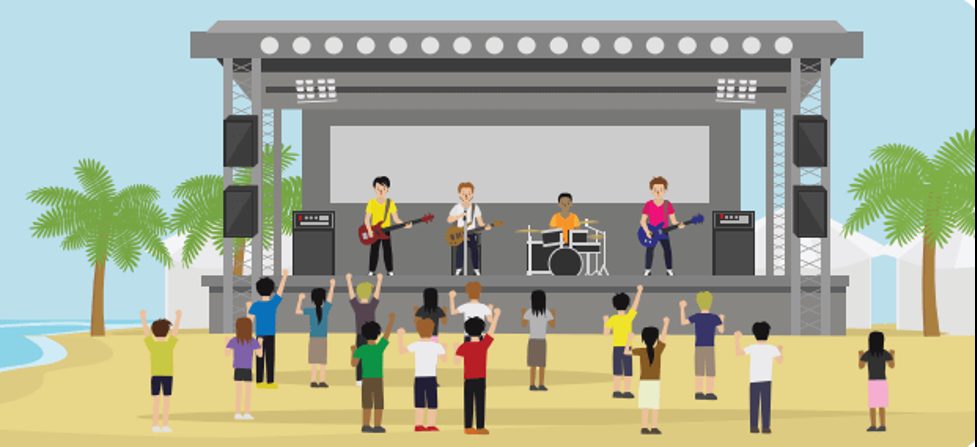
1. What kind of event is it? (Đây là loại sự kiện gì?)
2. Where does the event usually take place? (Sự kiện này thường diễn ra ở đâu?)
Gợi ý:
1. It is a music festival. (Đó là một lễ hội âm nhạc.)
2. It usually takes place at the stadium or on the beach. (Nó thường diễn ra tại sân vận động hoặc trên bãi biển.)
b. Bài tập 2
Listen to an interview about preparations for an International Youth Music Festival. Tick (V) the information that you hear in the recording. (Nghe một cuộc phỏng vấn về công tác chuẩn bị cho Lễ hội Âm nhạc Thanh niên Quốc tế. Đánh dấu (✔) vào thông tin mà bạn nghe được trong đoạn ghi âm.)
| A. Location | |
| B. Guests | |
| C. Decoration | |
| D. Tickets |
Bài nghe:
• Tam: Hi, this is Tam at the site of the second International Youth Music Festival. There are just two days to go before the festival opens on Sunday. As you can hear in the background it’s very busy here. I’m with Jack, one of the festival organisers. So, Jack, how’s it all going?
• Jack: Hi, we’re very busy. We’re still setting up the main stage and there’s still a lot to do, but we want to get it ready by tomorrow so that the bands can start to practise.
• Tam: I heard that there are some changes to the festival this year. Can you tell us about them?
• Jack: Well, last year the festival was on the beach and it was free of charge. We didn’t know it would be so popular and we had problems with overcrowding. This year we have sold the tickets in advance so that we know how many people are coming. What’s more important, we’ve decided to move the festival to this country park.
• Tam: Why the country park? Isn’t it a bit too far from the town centre?
• Jack: Yeah, that’s why we’ve chosen it. This location is better for everybody because…
Đáp án: A, D.
c. Bài tập 3
Listen again and decide whether the following statements are true (T) or false (F). (Nghe lại và quyết định các câu sau đây là đúng (T) hay sai (F)).
1. This is the first International Youth Music Festival.
2. The organisers have finished preparations for the festival.
3. Last year, the festival was held on the beach.
4. They are selling tickets for the festival at the park gates.
5. The country park is far from the town centre.
Đáp án:
1. F
2. F
3. T
4. F
5. T
7. Bài tập Writing – Tiếng Anh 10 Unit 3 Music (sách Global Success) (trang 34, 35)
a. Bài tập 1
Ann has just come back from a music event and shared her experience on a music website. Read her blog and complete the notes below. (Ann vừa trở về từ một sự kiện âm nhạc và đã chia sẻ trải nghiệm của mình trên một trang web về âm nhạc. Hãy đọc bài blog của cô ấy và hoàn thành phần ghi chú bên dưới.)
Last Saturday, I went to the International Youth Music Festival with some friends. This music event was even bigger and better than last year. There were a lot of exciting performances with many famous bands and singers from all over the world. I must say that they were really cool on stage! We had a chance to see our favourite idols perform live and listen to their greatest hits. We also tasted a lot of yummy food from different countries such as Korea, Mexico, and Thailand.
This year the festival took place in a big country park, so there was plenty of space for us to enjoy the music and relax. We all felt excited when going to this festival because we could make new friends and enjoy the party atmosphere…
Ann’s notes
• Event: International Youth Music Festival
• When: ________________
• Where: ________________
• Who with: ________________
• Atmosphere: ________________
• What we did: ________________
• How we felt: ________________
Đáp án:
Ann’s notes
• Event: International Youth Music Festival
• When: last Saturday
• Where: a big country park
• Who with: some friends
• Atmosphere: like a party
• What we did: saw our favourite idols perform live, listened to their greatest hits, tasted a lot of yummy food
• How we felt: excited
b. Bài tập 2
Work in groups. Put the words and phrases in the box below into the appropriate columns. Some words and phrases can go into more than one column. (Làm việc theo nhóm. Xếp các từ và cụm từ trong khung dưới đây vào các cột thích hợp. Một số từ và cụm từ có thể xếp vào nhiều hơn một cột.)
| amazing
excited relaxed stadium watch fireworks take photos play musical instruments |
friendly
beach wonderful fun play games see art exhibitions |
| Location | Atmosphere | Activities | Feeling |
|
|
Đáp án:
| Location | Atmosphere | Activities | Feeling |
| stadium
beach |
amazing
friendly wonderful relaxed fun |
watch fireworks
take photos play musical instruments play games see art exhibitions |
amazing
excited relaxed fun |
c. Bài tập 3
Imagine you went to a music event. Write a blog (about 120 words) to share your experience. Use the notes in 1 and the words and phrases in 2 to help you. (Hãy tưởng tượng bạn đã tham gia một sự kiện âm nhạc. Viết một bài blog (khoảng 120 từ) để chia sẻ trải nghiệm của bạn. Sử dụng các gợi ý trong phần 1 và các từ/cụm từ trong phần 2 để hỗ trợ bạn.)
Gợi ý:
Last weekend, I went to the International Youth Music Festival in Da Nang, and it was amazing! The event took place on the beach and attracted thousands of people. The stage was beautifully decorated with colorful lights and banners, creating a vibrant party atmosphere.
Many talented young artists from different countries performed various types of music, from pop and rock to traditional folk songs. I especially enjoyed a performance by a Vietnamese band playing the moon-shaped lute and bamboo clapper. It was so unique!
The audience was friendly and energetic. Everyone danced and sang along. I felt truly connected with people through music. This festival was not only fun but also a great chance to explore other cultures. I can’t wait to join again next year!
Dịch nghĩa:
Cuối tuần trước, mình đã tham dự Lễ hội Âm nhạc Thanh niên Quốc tế tại Đà Nẵng, và thật sự rất tuyệt vời! Sự kiện diễn ra trên bãi biển, thu hút hàng ngàn người tham gia. Sân khấu được trang trí rực rỡ với ánh đèn và cờ phướn đủ màu sắc, tạo nên một không khí lễ hội vô cùng sôi động.
Nhiều nghệ sĩ trẻ tài năng đến từ các quốc gia khác nhau đã biểu diễn nhiều thể loại nhạc, từ pop, rock cho đến các bài dân ca truyền thống. Mình đặc biệt ấn tượng với màn trình diễn của một ban nhạc Việt Nam sử dụng đàn nguyệt và phách tre – Nghe rất độc đáo!
Khán giả thì thân thiện và nhiệt tình. Ai cũng nhảy múa và hát theo. Mình cảm thấy âm nhạc thực sự đã kết nối mọi người lại với nhau. Lễ hội này không chỉ vui mà còn là cơ hội tuyệt vời để khám phá các nền văn hóa khác. Mình rất mong được tham gia lần nữa vào năm sau!
>>> Tìm hiểu thêm: Hướng dẫn 5 bước viết đoạn văn tiếng Anh có ví dụ cụ thể
8. Bài tập Communication and Culture (trang 34, 35)
COMMUNICATION
a. Bài tập 1
Listen and complete the following conversation with the expressions from the box. Then practise it in pairs. (Nghe và hoàn thành đoạn hội thoại sau với các cụm trong khung. Sau đó luyện tập theo cặp.)
Bài nghe:
• Ann: Do you have any plans for this Saturday evening?
• Mai: No, I don’t. (1)_________ we do something together?
• Ann: Yes, (2) _________. (3) _________ going to a music show? Let me check the weekend programme at the Modern Arts Centre. Look at their website!
• Mai: Wow, so many famous artists are going to perform there. This band looks so cool. (4) _________ go to the Saturday show.
• Ann: Sounds great!
Đáp án:
1. Shall
2. I’d love to
3. How about
4. Let’s
b. Bài tập 2
Work in pairs. Have similar conversations making and responding to suggestions about going to a music show. (Làm việc theo cặp. Thực hiện các đoạn hội thoại tương tự, đưa ra và đáp lại các gợi ý về việc đi xem một buổi biểu diễn âm nhạc.)
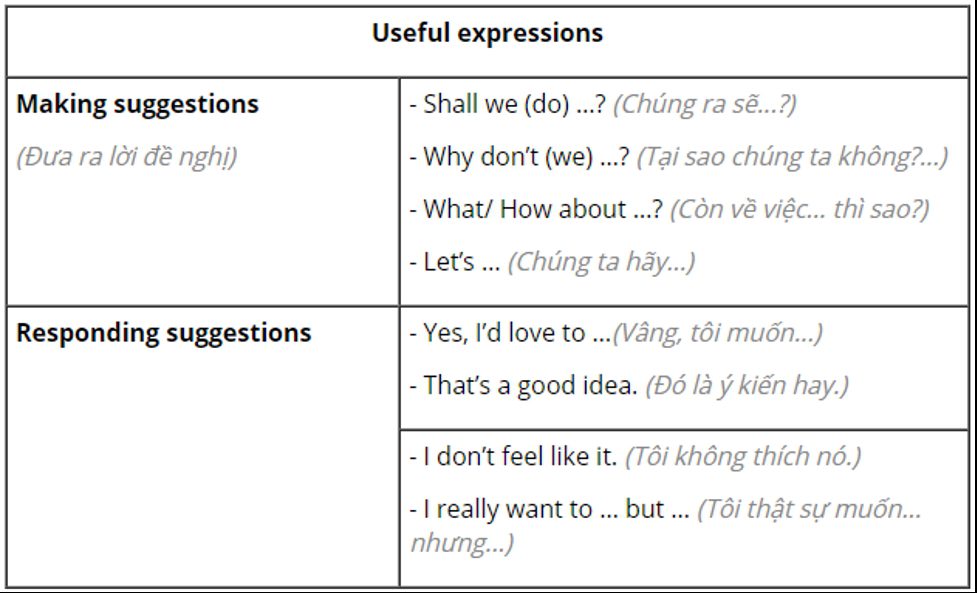
Gợi ý:
A: Do you have any plans for this weekend?
B: No, I don’t. Why don’t we do something together?
A: That’s a good idea. What about going to a live music show? Let me check the weekend programme at Swing cafe. Check out their Facebook page!
B: Wow, so many famous singers are going to perform there. Oh my god, it’s Orange, our favourite singer. Shall we go to the Saturday show?
A: Yes, I’d love to.
CULTURE
a. Bài tập 1
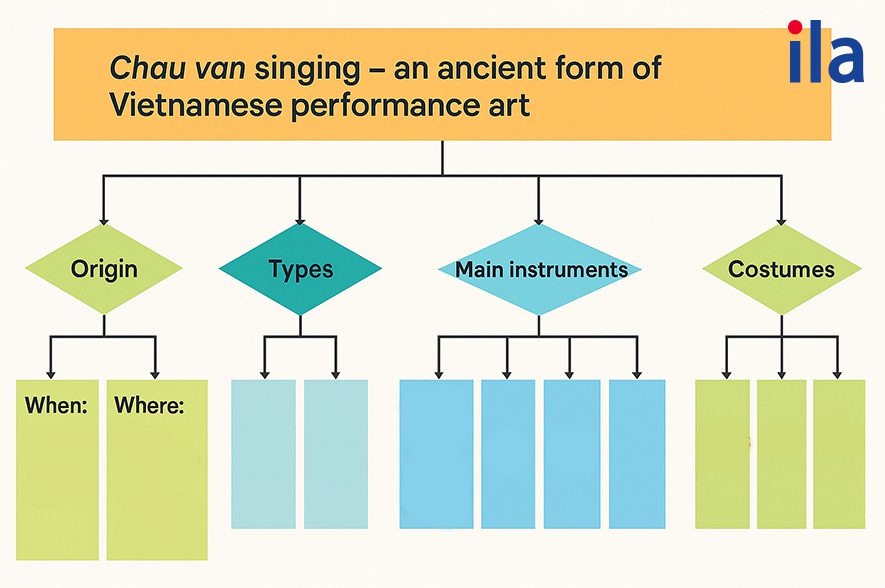
Read the passage about “chau van” singing and complete the mind map below. (Đọc một đoạn văn về hát chầu văn và hoàn thành sơ đồ tư duy bên dưới).
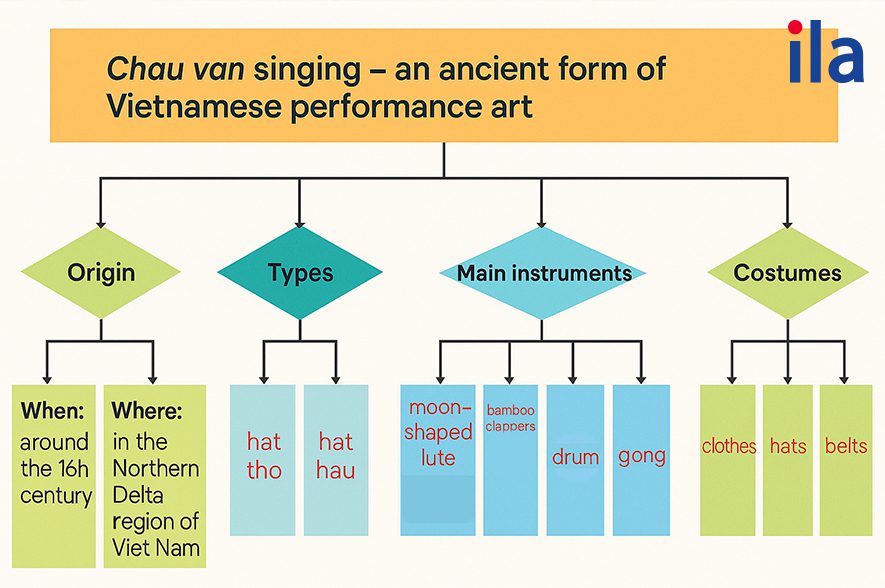
Chau van singing is an ancient form of Vietnamese performance art which combines singing and dancing. It started in the Northern Delta region of Viet Nam around the 16th century, and later spread to all parts of the country. It is used to praise the gods or national heroes.
There are several types of chau van singing. One typical type is hat tho or worship singing – the slow chanting including an act of worship. Another type is hat hau – the singing and dancing of a psychic.
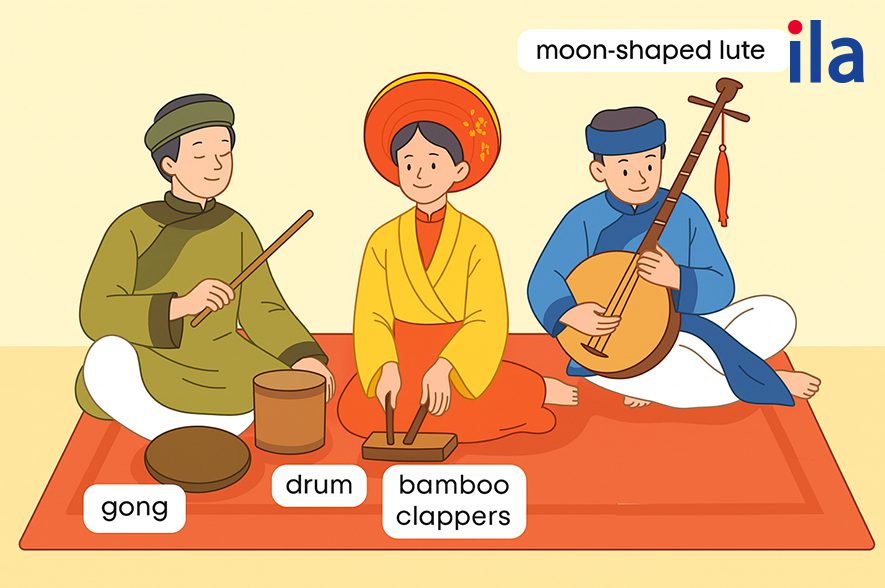
The main musical instruments used in chau van performance are the moon-shaped lute, bamboo clappers, drum, and gong.
The costumes of chau van performances are very important. The style of clothes, hats, and belts depends on the rank of the gods or saints the performers worship. It has changed over time, but the rules about the colours have stayed the same.
As a form of traditional performance art, chau van singing was recognized as part of Vietnamese national culture.
Đáp án:
b. Bài tập 2
Work in pairs. Tell your partner what you find most interesting about “chau van” singing. (Làm việc theo cặp. Hãy nói cho bạn cùng nhóm biết điều bạn thấy thú vị nhất về hát chầu văn.)
Gợi ý:
What I find most interesting about chau van singing is the performers’ costumes. Their clothes, hats, and belts look very special and beautiful. Every time I see them, I feel surprised and excited. The costumes are also unique and help show the beauty of Vietnamese culture.
Dịch nghĩa: Điều em thấy thú vị nhất về hát chầu văn là trang phục của người biểu diễn. Quần áo, mũ và thắt lưng trông rất đặc biệt và đẹp. Mỗi lần nhìn thấy, em cảm thấy bất ngờ và thích thú. Trang phục cũng rất độc đáo và thể hiện vẻ đẹp của văn hóa Việt Nam.
9. Bài tập Looking Back – Tiếng Anh 10 Unit 3 Music (trang 36)
PRONUNCIATION
Listen and mark the stressed syllables in the following words. Then read them out. (Nghe và đánh dấu các âm tiết được nhấn trong những từ sau. Sau đó đọc chúng lên.)
Đáp án:
| per’form | ‘concert | ‘final |
| ‘singer | ‘famous | en’joy |
VOCABULARY
Complete the following sentences using the words from the box. (Hoàn thành các câu sau bằng cách sử dụng các từ trong khung.)
|
artists music concerts instruments fans |
Our class survey revealed some surprising results about the students’ (1)______ habits. Most of them did not hesitate to say that they love music because they find it relaxing.
Their favourite music is K-pop and British or American pop music as they are big (2) ______ of Korean and American (3) ______. Fourteen out of twenty students play a musical (4) ______ and most of them practise between one and three hours a week. Going to (5) ______ is usually popular among teenagers, but only eight people said that they like going to such music events.
Đáp án:
1. music
2. fans
3. artists
4. instrument
5. concerts
GRAMMAR
a. Bài tập 1
Match the two parts to make complete sentences. (Ghép hai phần để tạo thành câu hoàn chỉnh).
| 1. She writes her own songs, | a. or we can stay at home to watch the final night at Vietnam Idol. |
| 2. He participated in many talent competitions, | b. so we decided to walk to the stadium. |
| 3. We can go to a live concert at City Theatre, | c. and they always have deep meanings. |
| 4. The traffic was really bad, | d. but the judges never liked his songs. |
Đáp án:
1. c
2. d
3. a
4. b
b. Bài tập 2
There is a mistake in each sentence below. Find the mistake and correct it. (Có một lỗi sai trong mỗi câu dưới đây. Tìm lỗi và sửa nó).
1. She asked him attend the school performance.
2. Don’t let her to go to the music festival!
3. Their parents will never agree buy that expensive piano.
4. To develop her musical talent, her father made her to sing at family gatherings.
Đáp án:
1. attend – sửa lại: to attend
2. to go – sửa lại: go
3. buy – sửa lại: to buy
4. to sing – sửa lại: sing
10. Project (trang 37)
Work in groups. Do research on a form of traditional music in Viet Nam or another country. (Làm việc nhóm. Nghiên cứu về một loại hình âm nhạc truyền thống ở Việt Nam hoặc quốc gia khác.)
Present your findings to the class. Your presentation should include: (Trình bày kết quả của bạn trước lớp. Bản trình bày của bạn nên bao gồm)
• When/ where it started (bắt đầu ở đầu/ khi nào)
• Instrument(s) (nhạc cụ)
• Types (loại)
• Artists/ performers (nghệ sĩ / người biểu diễn)
• Costumes (trang phục)
Gợi ý:
Hello everyone,
Today, our group would like to introduce Quan Ho singing, a traditional folk music from Bac Ninh and Bac Giang provinces in northern Vietnam. It started a few hundred years ago and is often performed during festivals, especially after the Lunar New Year.
Quan Ho singers usually perform in pairs – one male and one female – and they sing in a call-and-response style. The main instruments used are the bamboo flute and sometimes traditional drums.
There are many types of Quan Ho songs, including greeting songs, love songs, and farewell songs. Famous performers include people’s artists like Thuy Cai or Minh Thuy, who have helped preserve this cultural treasure.
Performers wear beautiful traditional costumes: female singers wear “áo tứ thân” with scarves and flat hats (nón quai thao), while male singers wear long tunics and turbans.
Quan Ho singing was recognized by UNESCO as an Intangible Cultural Heritage in 2009. It shows the beauty, politeness, and creativity in Vietnamese folk culture.
Thank you for listening!
Dịch nghĩa:
Xin chào tất cả các bạn,
Hôm nay, nhóm chúng em xin giới thiệu về hát Quan họ, một loại hình dân ca truyền thống đến từ tỉnh Bắc Ninh và Bắc Giang ở miền Bắc Việt Nam. Loại hình âm nhạc này bắt đầu cách đây vài trăm năm và thường được biểu diễn trong các lễ hội, đặc biệt là sau Tết Nguyên đán.
Người hát Quan họ thường hát theo cặp – một nam và một nữ – với lối hát đối đáp. Nhạc cụ chính thường được sử dụng là sáo trúc và đôi khi là trống truyền thống.
Quan họ có nhiều thể loại bài hát như hát chào hỏi, hát giao duyên và hát chia tay. Một số nghệ sĩ nổi tiếng đã góp phần bảo tồn Quan họ là NSND Thúy Cải, NSUT Minh Thùy.
Khi biểu diễn, nghệ sĩ mặc trang phục truyền thống rất đẹp: các liền chị mặc áo tứ thân, đội nón quai thao, còn các liền anh mặc áo dài và khăn xếp.
Hát Quan họ đã được UNESCO công nhận là Di sản Văn hóa Phi vật thể vào năm 2009. Đây là nét đẹp thể hiện sự lịch thiệp và sáng tạo trong văn hóa dân gian Việt Nam.
Cảm ơn các bạn đã lắng nghe!
Trên đây là toàn bộ đáp án và hướng dẫn chi tiết cho các bài tập trong sách giáo khoa tiếng Anh 10 Unit 3 Music (sách Global Success). ILA hy vọng rằng nội dung này sẽ giúp các bạn học sinh nắm vững kiến thức và học tập hiệu quả hơn.
>>> Tìm hiểu thêm: Artistic Gymnastics là gì? Nhớ nhanh 30+ từ vựng liên quan