
Tiếng Anh 10 Unit 1 Family Life là bài học đầu tiên trong chương trình Global Success giúp học sinh làm quen với từ vựng, ngữ pháp và các tình huống xoay quanh chủ đề cuộc sống gia đình. Trong bài này, các em sẽ được luyện kỹ năng nghe, nói, đọc, viết, cùng cách phát âm các tổ hợp phụ âm /br/, /kr/, /tr/. Ngoài ra, Unit 1 còn giúp ôn tập ngữ pháp về thì hiện tại đơn và hiện tại tiếp diễn, kết hợp hệ thống bài tập đa dạng kèm đáp án chi tiết, giúp học sinh tự tin nắm chắc kiến thức.
Tổng quan về bài học tiếng Anh lớp 10 Unit 1: Family Life sách mới
Bài tiếng Anh 10 Unit 1 Family Life (sách Global Success) giúp học sinh làm quen với từ vựng và tình huống xoay quanh chủ đề cuộc sống gia đình. Trong Unit này, bạn sẽ được rèn luyện các kỹ năng nghe, nói, đọc hiểu về hoạt động hằng ngày, vai trò của từng thành viên và cách chia sẻ việc nhà trong gia đình.
Ngoài ra, bạn còn được học cách phát âm tổ hợp phụ âm /br/, /kr/ và /tr/, đồng thời ôn lại ngữ pháp quan trọng về thì hiện tại đơn và hiện tại tiếp diễn trong tiếng Anh.
Lời giải chi tiết bài tập tiếng Anh 10 Unit 1 Family Life
1. Từ vựng tiếng Anh 10 Unit 1 Family Life
• Housework /ˈhaʊswɜːk/: Việc nhà
• Housewife /ˈhaʊswaɪf/: Người nội trợ (nữ)
• Task /tɑːsk/: Nhiệm vụ, công việc
• Bond /bɒnd/: Sự gắn bó, kết nối
• Value /ˈvæljuː/: Giá trị
• Traditional /trəˈdɪʃənl/: Truyền thống
• Proud /praʊd/: Tự hào
√ Động từ:
• Divide /dɪˈvaɪd/: Phân chia
• Look after /lʊk ˈɑːftə(r)/: Chăm sóc
• Tidy up /ˈtaɪdi ʌp/: Dọn dẹp gọn gàng
• Strengthen /ˈstreŋθn/: Củng cố, làm mạnh thêm
• Damage /ˈdæmɪdʒ/: Làm hư hại
• Grow up /ɡrəʊ ʌp/: Lớn lên, trưởng thành
• Celebrate /ˈselɪbreɪt/: Tổ chức, ăn mừng
√ Cụm từ:
• Household chores /ˌhaʊshəʊld ˈtʃɔːz/: Công việc nhà
• Homemaker /ˈhəʊmmeɪkə(r)/: Người nội trợ
• Breadwinner /ˈbredwɪnə(r)/: Người trụ cột đi làm nuôi gia đình
• Earn money /ɜːn ˈmʌni/: Kiếm tiền
• Do the heavy lifting /duː ðə ˌhevi ˈlɪftɪŋ/: Làm việc nặng nhọc
• Do the laundry /duː ðə ˈlɔːndri/: Giặt đồ
• Study for exams /ˈstʌdi fə(r) ɪɡˈzæmz/: Ôn tập chuẩn bị cho kỳ thi
• Life skill /ˈlaɪf skɪl/: Kỹ năng sống
• Take responsibility /teɪk rɪˌspɒnsəˈbɪləti/: Nhận trách nhiệm
• Take care of /teɪk ˈkeə(r) əv/: Chăm sóc
• Routine task /ruːˈtiːn tɑːsk/: Công việc thường ngày
• Do the washing-up /duː ðə ˌwɒʃɪŋ ˈʌp/: Rửa chén bát
>>> Tìm hiểu thêm: Điểm qua bộ từ vựng về gia đình tiếng Anh có thể bạn chưa gặp
2. Bài tập Getting Started – Tiếng Anh 10 Unit 1 Family Life (trang 8, 9)

Nội dung đoạn hội thoại:
• Nam: Hello, Minh.
• Minh: Hi, Nam. How are you? I’m going to play football at our school stadium with a few friends this evening. Are you free to join us?
• Nam: I’d love to, but I’m afraid I can’t. I’m preparing dinner.
• Minh: Really? Doesn’t your mum cook?
• Nam: Oh, yes. My mum usually does the cooking, but she’s working late today.
• Minh: How about your sister, Lan? Does she help with the housework?
• Nam: Yes. She often helps with the cooking. But she can’t help today. She’s studying for her exams.
• Minh: I see. I never do the cooking. It’s my mother’s job.
• Nam: Really? So how do you divide the household chores in your family?
• Minh: Mum is the homemaker, so she does the chores. My dad is the breadwinner, he earns money. And we, the kids, study.
• Nam: Well, in my family, we divide the housework equally – Mum usually cooks and shops for groceries: Dad cleans the house and does the heavy lifting.
• Minh: What about you and your sister?
• Nam: My sister does the laundry. I do the washing-up and put out the rubbish. We also help with the cooking when our mum is busy.
• Minh: That sounds fair! Anyway, I have to go now. See you later.
• Nam: Bye. Have fun.
a. Bài tập 1
Read the conversation again and decide whether the following statements are true (T) or false (F) (Đọc lại đoạn hội thoại và xác định các câu sau đây là đúng (T) hay sai (F)).
1. Nam’s mother is cooking now.
2. Everybody in Nam’s family does some of the housework.
3. The children in Minh’s family don’t have to do any housework.
Đáp án:
1. F
2. T
3. T
b. Bài tập 2
Write the verbs or phrasal verbs that are used with the nouns or noun phrases in the conversation in 1 (Viết các động từ hoặc cụm động từ được dùng với các danh từ hoặc cụm danh từ trong đoạn hội thoại ở bài 1).
| STT | Verbs / Phrasal Verbs | Nouns / Noun Phrases |
| 1 | put out | the rubbish |
| 2 | the laundry | |
| 3 | groceries | |
| 4 | the heavy lifting | |
| 5 | the washing-up |
Đáp án:
2. Do
3. Shop for
4. Do
5. Do
c. Bài tập 3
Complete the sentences from the conversation with the correct forms of the verbs in brackets (Hoàn thành các câu sau đây trong đoạn hội thoại bằng cách chia đúng dạng của các động từ trong ngoặc).
1. I’d love to, but I’m afraid I can’t. I (prepare) dinner.
2. My mum usually (do) the cooking but she (work) late today.
Đáp án:
1. I‘m preparing
2. does – is working
>>> Tìm hiểu thêm: Bài tập về từ loại trong tiếng Anh mới nhất (có đáp án)
3. Bài tập Language – Tiếng Anh lớp 10 Unit 1 Family Life sách mới (trang 9, 10)
A. PRONUNCIATION
√ Listen and repeat. Pay attention to the consonant blends /be/, /kr/ and /tr/ (Nghe và lặp lại. Chú ý đến các tổ hợp phụ âm /br/, /kr/ và /tr/).
| /br/ | /kr/ | /tr/ |
| breadwinner | crash | track |
| breakfast | crane | tree |
| brown | cream | train |
√ Listen to the sentences and circle the words you hear. (Nghe các câu và khoanh tròn những từ bạn nghe được).
1. a. brush b. crash c. trash
2. a. brain b. crane c. train
3. a. bread b. create c. tread
√ Nội dung bài nghe:
1. I’m worried he’s going to crash his car.
2. The train is moving fast.
3. I usually have bread for breakfast.
Đáp án:
1. b
2. c
3. a
B. VOCABULARY
a. Bài tập 1 – Tiếng Anh 10 Unit 1 Family Life
Match the words with their meanings (Nối các từ tương ứng với nghĩa của chúng).
| 1. breadwinner | a. a person who manages a home and often raises children instead of earning money |
| 2. housework | b. someone who earns the money to support their family |
| 3. groceries | c. picking up and carrying heavy objects |
| 4. homemaker | d. work around the house such as cooking, cleaning or washing clothes |
| 5. heavy lifting | e. food and other goods sold at a shop or a supermarket |
Đáp án:
1. b
2. d
3. e
4. a
5. c
b. Bài tập 2
Complete the sentences using the words in 1. (Hoàn thành các câu bằng cách sử dụng các từ bài 1).
1. My mother is a _________. She doesn’t go to work but stays at home to look after the family.
2. When I lived in this city, I used to shop for _________ at this supermarket.
3. My eldest son is strong enough to do the _________ for the family.
4. Hanna hates doing _________ except cooking.
5. Mr Lewis is the _________ of the family, but he still helps his wife with the housework whenever he has time.
Đáp án:
1. homemaker
2. groceries
3. heavy lifting
4. housework
5. breadwinner
C. GRAMMAR
a. Bài tập 1
Choose the correct form of the verb in each sentence. (Chọn dạng đúng của động từ trong mỗi câu.)
1. Mrs Lan usually does / is doing the cooking in her family.
2. I’m afraid he can’t answer the phone now. He puts out / is putting out the rubbish.
3. He cleans / is cleaning the house every day.
4. My sister can’t do any housework today. She studies / is studying for her exams.
5. My mother does / is doing the laundry twice a week.
Đáp án:
1. does
2. is putting out
3. cleans
4. is studying
5. does
Hướng dẫn giải:
1. Dùng thì hiện tại đơn vì có “usually”.
2. Dùng thì hiện tại tiếp diễn vì có “now”.
3. Dùng thì hiện tại đơn vì có “every day”.
4. Dùng thì hiện tại tiếp diễn vì có “today” (hành động bất ngờ không theo thói quen hằng ngày).
5. Dùng thì hiện tại đơn vì có “twice a week”.
b. Bài tập 2
Read the text and put the verbs in brackets in the present simple or present continuous (Đọc đoạn văn và chia các động từ trong ngoặc ở hiện tại đơn hoặc hiện tại tiếp diễn).
Mrs Lam is a housewife. Every day, she (1. do) most of the housework. She cooks, washes the clothes, and cleans the house. But today is Mother’s Day. So Mrs Lam (2. not do) any housework. At the moment, she (3. watch) her favourite TV programme. Her children (4. do) the cooking and her husband (5. tidy up) the house. Everybody (6. try) hard to make it a special day for Mrs Lam.
Đáp án:
1. does
2. is not doing
3. is watching
4. are doing
5. is tidying up
6. is trying
>>> Tìm hiểu thêm: Hiện tại đơn và hiện tại tiếp diễn: Cách phân biệt & bài tập chi tiết
4. Bài tập Reading (trang 11, 12)
a. Bài tập 1
Work in pairs. Look at the picture and answer the questions. (Thực hành theo cặp. Nhìn vào bức tranh và trả lời các câu hỏi.)
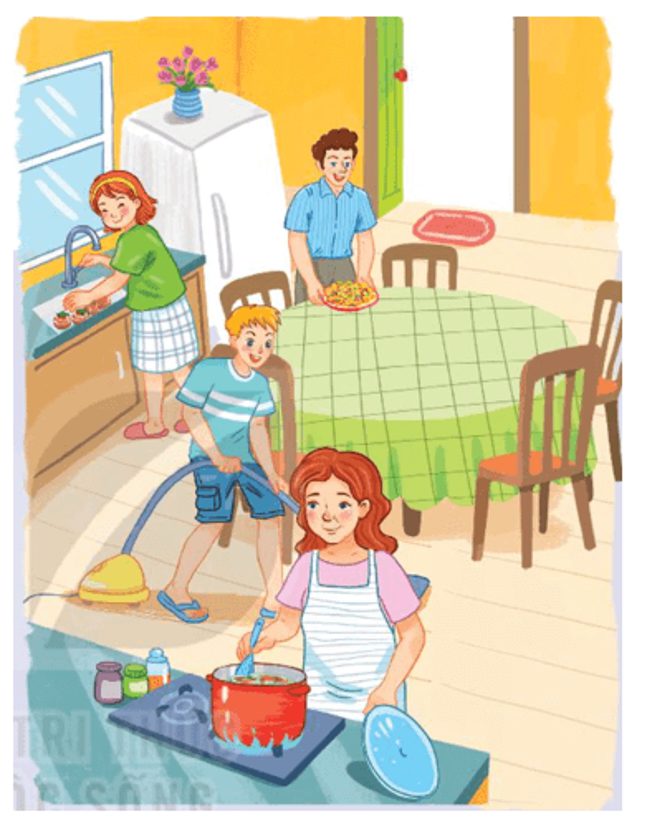
1. What is each person in the picture doing? (Mỗi người trong hình đang làm gì?)
2. Do you think that they are happy? Why or why not? (Bạn có nghĩ rằng họ đang hạnh phúc không? Tại sao có hoặc tại sao không?)
Gợi ý:
1. The mother is cooking, the father is laying the table, the son is cleaning the floor, the daughter is washing vegetables. (Mẹ đang nấu ăn, bố đang dọn bàn, con trai đang lau sàn, con gái đang rửa rau.)
2. I think they are happy, because they’re smiling. (Tôi nghĩ rằng họ đang hạnh phúc, bởi vì họ đang mỉm cười.)
b. Bài tập 2
Read the text and choose the correct answer. (Đọc đoạn văn và chọn đáp án đúng)
Most people think that housework is boring and is the responsibility of wives and mothers only. Many parents don’t ask their children to do housework so that they have more time to play or study. However, studies show doing chores is good for children.
Kids who do housework develop important life skills that they will need for the rest of their lives. Doing the laundry, cleaning the house, and taking care of others are among the important skills that children will need when they start their own families. These are the things that schools cannot fully teach, so it’s important for children to learn them at home.
Sharing housework also helps young people learn to take responsibility. They know that they have to try to finish their tasks even though they do not enjoy doing them. Doing chores also helps develop children’s gratitude to their parents. When doing housework, they learn to appreciate all the hard work their parents do around the house for them. In addition, doing chores together helps strengthen family bonds, creating special moments between children and parents. It makes children feel they are members of a team.
All in all, doing housework can bring a lot of benefits to children. It teaches them life skills and helps build their character. Therefore, parents should encourage their kids to share the housework for their own good as well as the good of the whole family.
1. Responsibility
a. Duty
b. Hobby
2. Gratitude
a. The feeling of being great
b. The feeling of being grateful
3. Strengthen
a. Make something stronger
b. Make something more difficult
4. Bonds
a. Close connections
b. Common interests
5. Character
a. Qualities that make a person the same as others
b. Qualities that make a person different from others
Đáp án:
1. a
2. b
3. a
4. a
5. b
c. Bài tập 3
Read the text again and answer the questions. (Đọc lại đoạn văn và trả lời các câu hỏi.)
1. What do most people think about housework? (Hầu hết mọi người nghĩ gì về việc nhà?)
2. Why don’t many parents make their children do housework? (Tại sao nhiều bậc cha mẹ không bắt con mình làm việc nhà?)
3. What are some important life skills children can learn when doing housework? (Trẻ em có thể học được những kỹ năng sống quan trọng nào khi làm việc nhà?)
4. What do children learn as they finish household tasks that they don’t enjoy? (Trẻ học được điều gì khi hoàn thành những việc nhà mà chúng không thích?)
5. Why does sharing housework strengthen family bonds? (Tại sao việc chia sẻ việc nhà lại giúp gắn kết các thành viên trong gia đình?)
Đáp án:
1. Most people think that housework is boring and is the responsibility of wives and mothers only. (Hầu hết mọi người nghĩ rằng việc nhà nhàm chán và chỉ là trách nhiệm của vợ và mẹ.)
2. They want to give their children more time to play or study. (Họ muốn cho con mình có thêm thời gian chơi hoặc học.)
3. These are doing the laundry, cleaning the house, and taking care of others. (Đó là giặt giũ, dọn dẹp nhà cửa và chăm sóc người khác.)
4. They learn that they have to try to finish their tasks even though they do not enjoy doing them. (Các em học được rằng mình cần cố gắng hoàn thành công việc dù không thích làm.)
5. Because children learn to appreciate all the hard work their parents do around the house for them. (Vì trẻ học cách trân trọng tất cả những việc vất vả mà cha mẹ làm cho chúng trong nhà.)
d. Bài tập 4
Work in pairs. Discuss the question. (Thực hành theo cặp. Thảo luận câu hỏi).
What benefits do you think you can get from sharing housework? (Bạn nghĩ mình có thể nhận được những lợi ích gì từ việc chia sẻ việc nhà?)
Gợi ý:
• It helps save time and energy. (Giúp tiết kiệm thời gian và công sức.)
• It makes family members feel more responsible. (Giúp các thành viên trong gia đình cảm thấy có trách nhiệm hơn.)
• It creates a more equal and respectful family environment. (Tạo ra môi trường gia đình công bằng và tôn trọng hơn.)
• It reduces stress and pressure for one person. (Giảm căng thẳng và áp lực cho một người.)
• It improves teamwork and communication in the family. (Cải thiện khả năng làm việc nhóm và giao tiếp trong gia đình.)
• It teaches children good life skills. (Dạy trẻ những kỹ năng sống tốt.)
• It helps keep the house clean and organized. (Giúp giữ cho nhà cửa sạch sẽ và ngăn nắp.)
• It brings family members closer together. (Gắn kết các thành viên trong gia đình hơn.)
• It prevents arguments about chores. (Tránh các cuộc cãi vã về việc nhà.)
• It gives everyone more free time to relax or enjoy hobbies. (Giúp mọi người có thêm thời gian rảnh để thư giãn hoặc làm điều mình thích.)
>>> Tìm hiểu thêm: Muốn giỏi Reading? Bỏ túi ngay 10+ trang web cực chuẩn này!
5. Bài tập Speaking – Tiếng Anh 10 Unit 1 Family Life (trang 12)
a. Bài tập 1
Below are reasons why children should or shouldn’t do housework. Put them in the correct column. Add some more if you can. (Dưới đây là những lý do vì sao trẻ em nên hoặc không nên làm việc nhà. Hãy xếp chúng vào cột phù hợp. Nếu có thể, hãy thêm một vài lý do khác.)
1. Doing housework helps them develop life skills.
2. Doing housework teaches them to take responsibility.
3. Kids should be given plenty of playtime when they are young.
4. They may break or damage things when doing housework.
5. Doing housework helps strengthen family bonds.
6. They need more time to study and do homework.
Đáp án:
Should: 1, 2, 5.
Shouldn’t: 3, 4, 6.
b. Bài tập 2:
Work in pairs. Complete the conversation between Anna, Nam, and Minh using some ideas from 1. Then listen to the conversation and check your answers (Thực hành theo cặp. Hoàn thành đoạn hội thoại giữa Anna, Nam và Minh bằng cách sử dụng một số ý tưởng từ bài 1. Sau đó nghe đoạn hội thoại và kiểm tra đáp án của bạn).
Bài nghe:
Anna: Nam, why do you think children should do housework?
Nam: Because (1) ___________.
Anna: It’s true. Life skills such as cooking, cleaning or taking care of others are really necessary for kids when they grow up.
Nam: Yes, we should all have these basic life skills to be adults.
Anna: Now Minh, why do you think children shouldn’t do housework?
Minh: I think kids are kids. (2) ___________.
Nam: I don’t agree with you. I’m afraid too much playtime isn’t good for children.
Anna: Well, thank you both for sharing your ideas. They are very useful for my project.
Đáp án:
1. Because doing housework helps them develop life skills.
2. They should be given plenty of playtime when they are young.
c. Bài tập 3
Work in groups. Have similar conversations exchanging opinions about whether children should or shouldn’t do housework. You can use the ideas from 1 and the reading text. (Làm việc theo nhóm. Thực hiện các đoạn hội thoại tương tự để trao đổi ý kiến về việc trẻ em có nên hay không nên làm việc nhà. Bạn có thể sử dụng các ý tưởng từ bài 1 và đoạn văn đã đọc.)
Gợi ý:
• Anna: Nam, in your opinion, why should children do housework? (Nam, theo bạn thì tại sao trẻ em nên làm việc nhà?)
• Nam: Because doing housework helps them learn how to be responsible. (Vì làm việc nhà giúp các em học cách có trách nhiệm.)
• Anna: That’s true. Learning to take responsibility is really important when we grow up. (Đúng vậy. Học cách chịu trách nhiệm rất quan trọng khi chúng ta trưởng thành.)
• Nam: Yes, I believe everyone should be responsible, even for the smallest tasks. (Ừ, mình nghĩ ai cũng nên có trách nhiệm, kể cả với những việc nhỏ nhất.)
• Anna: Minh, how about you? Why do you think children shouldn’t do housework? (Còn bạn thì sao, Minh? Tại sao bạn nghĩ trẻ em không nên làm việc nhà?)
• Minh: I think kids can be careless. They might break or damage things while doing housework. (Mình nghĩ trẻ con có thể bất cẩn. Các em có thể làm hỏng hoặc vỡ đồ khi làm việc nhà.)
• Nam: I don’t agree with you. Some kids are even more careful than adults, for example, my three-year-old nephew. (Mình không đồng ý với bạn. Một số trẻ còn cẩn thận hơn cả người lớn, ví dụ như cháu trai ba tuổi của mình.)
• Anna: Well, thank you both for sharing your thoughts. Your ideas are really helpful for my project. (Cảm ơn hai bạn đã chia sẻ ý kiến. Những ý tưởng của các bạn thực sự rất hữu ích cho bài dự án của mình.)
>>> Tìm hiểu thêm: Đừng chỉ nói “Yes”. 30+ cách nói đồng ý tiếng Anh đậm chất bản xứ
6. Bài tập Listening (trang 13)
a. Bài tập 1
Work in pairs. Look at the picture and answer the questions (Làm việc theo cặp. Nhìn vào bức tranh và trả lời các câu hỏi).

1. What can you see in the picture? (Bạn có thể thấy gì trong bức tranh?)
2. What do you think the students is talking about? (Bạn nghĩ học sinh đó đang nói về điều gì?)
Gợi ý:
1. An interviewer and a student are in a talk show. (Một người phỏng vấn và một học sinh đang tham gia một chương trình trò chuyện.)
2. He’s talking about his family life and how his family have helped him achieve success in his studies. (Cậu ấy đang nói về cuộc sống gia đình của mình và cách gia đình đã giúp cậu đạt được thành công trong học tập.)
b. Bài tập 2
Listen to the introduction to the talk show and check whether your answer to Question 2 above is correct or not (Nghe phần giới thiệu của chương trình trò chuyện và kiểm tra xem câu trả lời của bạn cho câu hỏi 2 phía trên có đúng hay không.)
Nội dung bài nghe:
Welcome to our talk show. Tonight our topic is ‘Family Life’ and our guest speaker is Le Minh Hieu. Hieu is a twelfth-grader. He’s just won a gold medal at the international Physics Olympiad. He’ll tell us about his family life and how his family has helped him achieve success in his studies.
c. Bài tập 3
Listen to the talk show and decide whether the statements are true (T) or false (F) (Nghe chương trình trò chuyện và xác định các câu sau là đúng (T) hay sai (F)).
Nội dung bài nghe:
• Hieu: Good evening. Well, I live with my parents and my brother. And I must say that all my achievements are the result of their support.
• Host: Do your parents help you with your studies?
• Hieu: My parents are farmers. They know little about physics. But they believe in me. They always listen to me and cheer me up whenever I have difficulties.
• Host: So they encourage you to try harder?
• Hieu: That’s right. Their love and trust give me strength to carry on.
• Host: How about your brother?
• Hieu: My brother is my best friend. He shares his happy and sad moments with me, and is always there for me when I need help.
• Host: You’re so lucky to have a supportive family. Do you spend a lot of time together?
• Hieu: Yes. My parents have created some family routines so that every week we can spend some time together although we’re all very busy.
• Host: Family routines? Can you tell us more about that?
• Hieu: Well, family routines are …
1. There are three people in Hieu’s family.
2. Hieu’s parents teach him physics.
3. When Hieu needs help, his brother always helps him.
4. Hieu’s family routines help them spend some time together every week.
Đáp án:
1. F
2. F
3. T
4. T
d. Bài tập 4
Listen again and complete each sentence with ONE word from the recording (Nghe lại và hoàn thành mỗi câu với MỘT từ xuất hiện trong đoạn ghi âm).
1. Hieu’s parents always listen to him and cheer him up whenever he has _______.
2. His parents’ ______ and trust give him strength to carry on.
3. Hieu’s brother is his best friend. He shares his happy and _______ moments with him.
Đáp án:
1. difficulties
2. love
3. sad
Nội dung bài nghe:
1. My parents are farmers. They know little about physics. But they believe in me. They always listen to me and cheer me up whenever I have difficulties.
2. That’s right. Their love and trust give me strength to carry on.
3. My brother is my best friend. He shares his happy and sad moments with me, and is always there for me when I need help.
e. Bài tập 5
Work in groups. Discuss the following question (Làm việc nhóm. Thảo luận câu hỏi sau).
How can parents help their children achieve success in their studies? (Cha mẹ có thể giúp con đạt được thành công trong học tập bằng cách nào?)
Gợi ý:
• My parents help me by creating a quiet place to study at home, so I can focus better on my homework. (Bố mẹ giúp em bằng cách tạo một nơi yên tĩnh để học ở nhà, nhờ vậy em có thể tập trung làm bài tập hơn.)
• They remind me to follow a study schedule, which helps me manage my time well between studying and relaxing. (Họ nhắc em tuân theo thời gian biểu học tập, điều này giúp em quản lý tốt thời gian giữa học và nghỉ ngơi.)
• They sometimes sit with me to check my homework or explain things I don’t understand. (Thỉnh thoảng họ ngồi cùng em để kiểm tra bài tập hoặc giải thích những điều em chưa hiểu.)
• They always encourage me when I try hard, even if I don’t get the best mark. That makes me feel more confident. (Họ luôn động viên em khi em cố gắng, dù em không đạt điểm cao nhất. Điều đó khiến em cảm thấy tự tin hơn.)
>>> Tìm hiểu thêm: Nghe tiếng Anh thụ động: Bí kíp luyện nghe hiệu quả
7. Bài tập Writing – Tiếng Anh lớp 10 Unit 1 Family Life sách mới (trang 14, 15 )
a. Bài tập 1
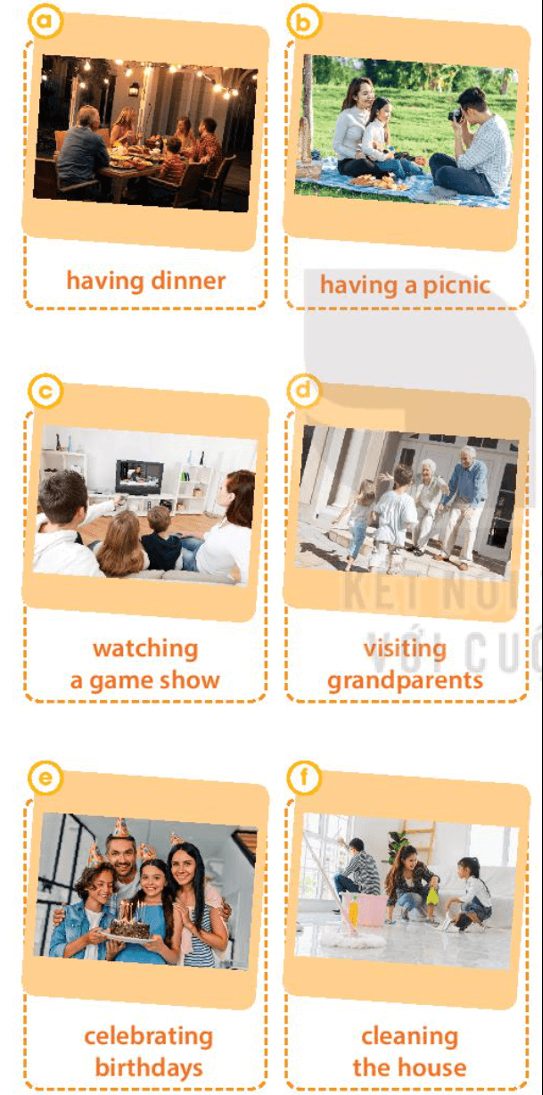
Work in groups. Which of the following activities in the pictures do you think can be family routines? (Làm việc theo nhóm. Bạn nghĩ hoạt động nào trong số các hoạt động trong hình dưới đây có thể là thói quen sinh hoạt của gia đình?)
Hướng dẫn dịch:
a. Ăn tối
b. Đi dã ngoại
c. Xem chương trình trò chơi truyền hình
d. Thăm ông bà
e. Tổ chức sinh nhật
f. Dọn nhà
b. Bài tập 2
Read Joey’s email about his family routines and complete the table with the information from it (Đọc email của Joey về các thói quen sinh hoạt trong gia đình cậu ấy và hoàn thành bảng thông tin dựa trên nội dung trong email).
To: dong@webmail.com
Subject: My family routines
Hi Dong,
How are you getting on? In your last email you asked me about my family routines. Well, we have quite a few routines to help us learn life skills and build family bonds, but I’ll tell you about three main ones.
First, my family always has dinner together. Dinners are important for us since we share our daily experiences and talk about the latest news. Second, we watch our favourite game show on TV together every Friday evening. We discuss the questions and guess the answers. It’s great fun every time we get a correct answer. Third, once every two weeks, on Saturday we clean the house together. We make a list of all the chores. Each of us then chooses one or two household tasks according to personal choice. We all feel happy and proud when we see our home spotlessly clean at the end of the day.
Do you have similar family routines? I’d be interested to know about your family.
Please write back soon.
Best,
Joey
| Routines | When/ How often | Things to do to strengthen family bonds |
| 1. Have dinner together | ||
| 2. | Every Friday evening | |
| – Make a list of chores
– Choose tasks |
Đáp án:
| Routines | When/ How often | Things to do to strengthen family bonds |
| 1. Have dinner together | Always | – Share our daily experiences
– Talk about the latest news |
| 2. Watch favourite game show on
TV together |
Every Friday evening | – Discuss the questions
– Guess the answers |
| 3. Clean the house together | Every two weeks | – Make a list of chores
– Choose tasks |
c. Bài tập 3
Complete the email about Dong’s family routines using the information in the box (Hoàn thành email về những thói quen sinh hoạt của gia đình Đông bằng cách sử dụng thông tin trong bảng dưới đây.)
| Routines | When/ How often | Things to do to strengthen family bonds |
| 1. Have breakfast together | Every day | – Eat bread or noodles
– Share their plans for the day |
| 2. Watch TV together | Every Saturday evening | – Watch a film and share snacks
– Exchange opinions after the film |
| 3. Visit grandparents | On the second Sunday of the month | – Do some housework for grandparents
– Have lunch with them |
Hi Joey,
How are you? We’re all doing fine here. You asked me about my family routines. Well, we have several routines that not only help us develop life skills but also bring our family closer together. Let me share three of the most important ones.
We have breakfast together every day. We usually eat bread or noodles, and during breakfast, we often share our plans for the day. It’s a great way to start the morning and understand what everyone will be doing.
Every Saturday evening, we watch TV together. We often watch a film and share some snacks like popcorn or fruit. After the film, we usually exchange our opinions about it. It’s fun and helps us understand each other better.
On the second Sunday of every month, we visit our grandparents. We help them do some housework and then have lunch together. These visits make our bond with them stronger and show them how much we care.
Best wishes,
Dong
>>> Tìm hiểu thêm: Bài tập viết lại câu lớp 10 giúp bạn nâng cao kỹ năng viết
8. Communication and Culture / CLIL – Tiếng Anh 10 Unit 1 Family Life (trang 15, 16)
A. EVERYDAY ENGLISH
a. Bài tập 1
Listen and complete the conversation with the expressions in the box. Then practise it in groups of three (Nghe và hoàn thành đoạn hội thoại bằng các cụm từ trong ô. Sau đó, luyện tập theo nhóm ba người).
|
A. I strongly believe that B. I’m not sure about that C. I have no doubt that |
Bài nghe:
• Anna: Do you guys think that teenagers should do housework?
• Minh: Yes, (1) teenagers as well as other members of the family should share the housework.
• Anna: Do you mean everybody in the family has to help with the housework?
• Minh: That’s right. (2) doing household chores together helps build family bonds.
• Tu: Well, (3). Teenagers should spend all their time studying instead of doing housework. They’ll need good grades to get into top universities.
Đáp án:
1. A
2. C
3. B
b. Bài tập 2
Work in groups. Have similar conversations exchanging opinions about whether family members should spend time together (Làm việc theo nhóm. Thực hiện các đoạn hội thoại tương tự để trao đổi ý kiến về việc các thành viên trong gia đình có nên dành thời gian bên nhau hay không.)
Gợi ý:
• Maya: Do you guys think family members should spend time together? (Các bạn có nghĩ rằng các thành viên trong gia đình nên dành thời gian bên nhau không?)
• Jason: Yes, I think spending time together is really important. Every family member should try to be with others whenever they can. (Ừ, mình nghĩ dành thời gian bên nhau rất quan trọng. Mỗi người trong gia đình nên cố gắng ở bên nhau khi có thể.)
• Maya: So you mean doing things together, like housework? (Ý bạn là làm việc gì đó cùng nhau, như việc nhà chẳng hạn?)
• Jason: Exactly. I believe that when family members spend time with each other, it helps make their bond stronger. (Chính xác. Mình tin rằng khi các thành viên trong gia đình dành thời gian cho nhau, mối quan hệ giữa họ sẽ gắn bó hơn.)
• Han: Well, I think sometimes it’s not always a good idea. You know, everyone has a different schedule, so it can be hard to find time that works for all. And if some people are free but others aren’t, it might lead to arguments. (Ừm, mình nghĩ đôi khi điều đó không phải lúc nào cũng tốt. Mỗi người có lịch sinh hoạt khác nhau, nên khó sắp xếp thời gian chung. Nếu có người rảnh mà người khác thì không, điều đó có thể dẫn đến mâu thuẫn.)
B. CULTURE
a. Bài tập 1
Read the text and list the five family values of British people in the 21st century in the table below (Đọc đoạn văn và liệt kê năm giá trị gia đình của người Anh trong thế kỷ 21 vào bảng dưới đây).
Family values are ideas about how people want to live their family life and are passed on from parents to children. Strong family values can prepare children for a happy life. Results of a recent survey in the UK show that even though modern family life has changed greatly, a number of traditional family values are still important in the UK nowadays.
On top of the list are the values of being truthful and honest, and respecting older people. Children are taught to tell the truth from an early age. They learn to show respect to older people, who have a wealth of life experiences. Having good table manners is the third important family value. Coming fourth and fifth on the list are the values of remembering to say please and thank you, and helping with family chores respectively.
It is clear that in the 21st century, British people still follow some traditional family values.
Đáp án:
1. Being truthful and honest (sống trung thực và thật thà).
2. Respecting older people (tôn trọng người lớn tuổi).
3. Having good table manners (cư xử lịch sự khi ăn uống).
4. Remembering to say “please” and “thank you” (nhớ nói “làm ơn” và “cảm ơn”).
5. Helping with family chores (giúp đỡ làm việc nhà trong gia đình).
b. Bài tập 2
Work in pairs. Discuss whether Vietnamese people have similar family values (Làm việc theo cặp. Thảo luận xem người Việt Nam có những giá trị gia đình tương tự hay không.)
Gợi ý:
Vietnamese families share some similar values with British families. Honesty and respect for the elderly are among the most important. From a young age, children are taught not to lie and to always be truthful. They also learn to be polite and respectful to older people. In addition, having good manners at the table is considered an important value in Vietnamese culture. (Gia đình Việt Nam cũng có một số giá trị tương tự như gia đình Anh. Trung thực và tôn trọng người lớn tuổi là những giá trị quan trọng hàng đầu. Ngay từ nhỏ, trẻ em được dạy không được nói dối và phải luôn thành thật. Các em cũng học cách cư xử lễ phép và tôn trọng người lớn. Ngoài ra, việc cư xử lịch sự trong bữa ăn cũng được xem là một giá trị quan trọng trong văn hóa Việt Nam).
>>> Tìm hiểu thêm: Top câu hỏi đố vui cực hay giúp rèn luyện trí thông minh và tư duy logic
9. Bài tập Looking back (trang 16)

a. Bài tập 1
Listen and write /br/, /kr/ or /tr/ above the word that has the corresponding consonant blends. Then practise reading the sentences. (Nghe và viết /br/, /kr/ hoặc /tr/ phía trên từ có tổ hợp phụ âm tương ứng. Sau đó, luyện đọc các câu đó.)
Đáp án:
1. I like ice cream (/kr/), but my brother (/br/) likes bread (/br/) pudding.
2. Tracy (/tr/) crashed (/kr/) her car into a tree (/tr/) and broke (/br/) her leg.
3. They often have crab (/kr/) soup for breakfast (/br/).
b. Bài tập 2
Complete the text. Use the correct forms of the word and phrases in the box. (Hoàn thành đoạn văn. Sử dụng đúng dạng của các từ và cụm từ trong bảng.)
| – do the washing-up
– do the heavy lifting – do the cooking – clean the house – laundry |
In Thanh’s family, everybody shares the housework. His mother (1). Thanh really enjoys the food she cooks. Thanh’s father is a strong man, so he (2). Thanh helps with the (3). He feels proud that he knows how to run a washing machine. Thanh’s sister helps with (4). She does it regularly, so their house is never dirty. She also (5) after each meal.
Đáp án:
1. does the cooking
2. does the heavy lifting
3. laundry
4. cleaning the house
5. does the washing-up
b. Bài tập 2
There is a mistake in each sentence below. Find the mistake and correct it (Có một lỗi sai trong mỗi câu dưới đây. Hãy tìm lỗi sai và sửa lại cho đúng.)
1. I’m writing to you to tell you how much I’m wanting to see you.
2. Jack is away on business, so now I look after his dog.
3. Nam’s often looking untidy.
4. She can’t answer the phone now. She cooks dinner.
5. Excuse me, do you read the newspaper? Could I borrow it?
6. What are your family doing in the evenings?
Đáp án:
1. I‘m wanting – sửa lại: want
2. look – sửa lại: ‘m/ am looking
3. Nam‘s often looking – sửa lại: (often) looks
4. cooks – sửa lại: is cooking
5. do you read – sửa lại: are you reading
6. are … doing – sửa thành: do … do
>>> Tìm hiểu thêm: Bài tập ngữ pháp tiếng Anh có đáp án hiệu quả cho mọi trình độ
10. Project (trang 17) – Tiếng Anh 10 Unit 1 Family Life
Work in groups. Do research on Family Day in Viet Nam or other countries in the world (Làm việc theo nhóm. Tìm hiểu về Ngày Gia đình ở Việt Nam hoặc ở các quốc gia khác trên thế giới).
Gợi ý:
• Where it is celebrated? (Ngày này được tổ chức ở đâu?)
• When it is celebrated (Thời gian tổ chức?)
• When was it first celebrated? (Lần đầu tiên được tổ chức là khi nào?)
• Why it is celebrated (Lý do vì sao ngày này được tổ chức?)
• What do people often do to celebrate the day? (Mọi người thường làm gì để kỷ niệm ngày này?)
Trên đây là toàn bộ đáp án và phần giải thích chi tiết cho bài học tiếng Anh 10 Unit 1 Family Life (Global Success). Qua bài viết này, ILA mong rằng các em học sinh sẽ cảm thấy tự tin hơn trong quá trình học tập.
>>> Tìm hiểu thêm: Viết email tiếng Anh: Tưởng khó mà dễ nếu biết 6 bí kíp này!